
Is Volvo the Best Employer in Poland in 2025?


Volvo has become one of the most popular employers in Poland’s industrial landscape. The company operates major businesses across trucks, cars, buses, construction equipment, and digital services, giving it a footprint far larger than most people realize. It has a strong reputation as an employer, with both manufacturing and office-based roles advertised to potential employees.
With Toyota, Mercedes-Benz, MAN, and Volkswagen all fighting for the same talent, the real question is simple: Is Volvo the best employer in Poland in 2025?
Volvo in Poland 2025: Operations and Workforce Size
Volvo (AB Volvo) remains a major employer in Poland, with operations spanning Volvo Trucks (Mlochow near Warsaw), Volvo Buses, Volvo Construction Equipment (R&D in Wroclaw), and corporate functions (including IT, finance, HR, etc.).
Overall, more than 2,100 Poles now work for Volvo in Poland, mostly at Volvo Trucks, Volvo CE, and support services. In fact, Volvo Trucks Poland (Mlochow) is repeatedly certified as a Top Workplace: it earned Great Place to Work “Legend” status (five years on the Best Workplaces list).
These facts underline Volvo’s significant local presence in both blue-collar (factory) and white-collar (office/IT) roles.
Volvo in Poland’s Top Employer Rankings 2025
In Polish employer surveys, Volvo consistently rates highly. For example, the 2024 Randstad Employer Brand Research named Volvo the #1 most attractive employer in Poland (among all industries). However, in the 2025 Randstad poll (4,600 respondents), Volvo slipped to #3 overall (behind e‑commerce leader Allegro and LG Energy Solution Wroclaw).
The same study highlighted Volvo as having a “very good reputation and equal employment opportunities” in the workplace. However, Forbes/Statista’s Poland Best Employers ranking (2025) is dominated by tech and retail firms, and Volvo did not appear in its national top 10. Among auto/manufacturing, BMW, Bosch, and Mercedes Poland often appear above Volvo in those broad lists.
Domestically, Volvo’s factories and staff programs often win awards. In 2024, Volvo Trucks Poland was honored by Forbes and other bodies for workplace quality. It also touts extensive employee wellness initiatives (e.g. on-site yoga, stress webinars, and free confidential counseling for any worker, fully paid by the company) that apply to all personnel (manufacturing and office-based).
Meanwhile, on Universum’s Most Attractive Employers ranking, Volvo ranked #7 in 2023 and dropped to #8 in 2024 in the Engineering category.
Alicja Zarzycka, Country Manager of Employer Branding at Volvo, emphasized regarding mental health programs that “all companies…whatever they do, blue or white collar, this applies to everyone”. Employee surveys at Volvo reflect this focus. The company cites high engagement with its support programs and notes that “caring for emotional balance is an important part of…everyone’s happiness.”
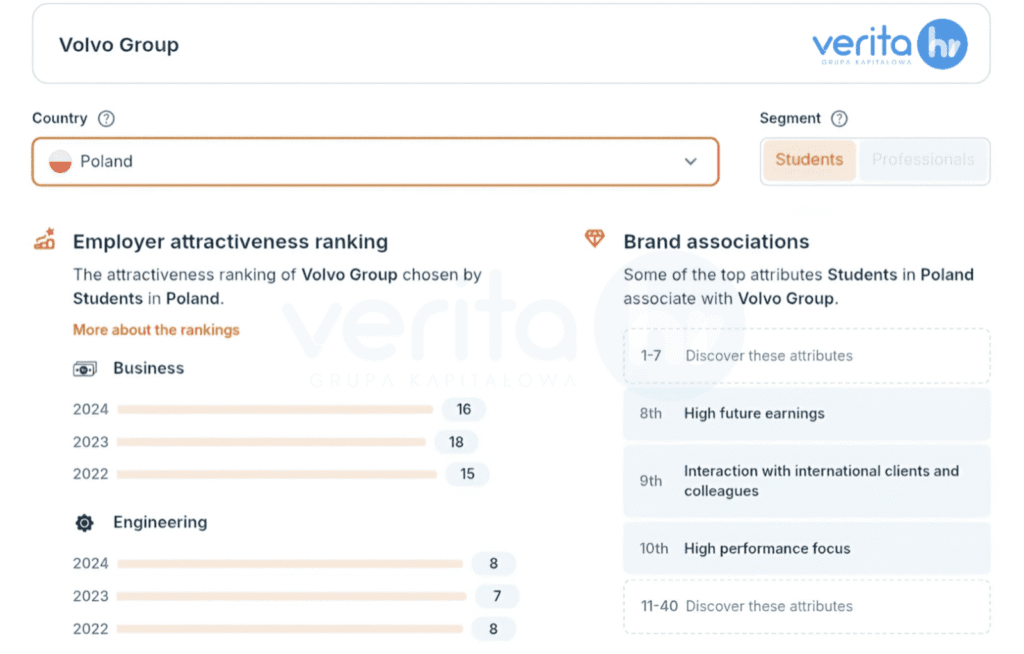
Source: Universum Global
How Volvo Compares to Other Automotive Employers in Poland
Volvo ranks near the top of automotive employers but faces tight competition. Toyota Motor Manufacturing Poland (TMMP) is the closest peer to Volvo: Randstad placed Toyota #3 in 2024 and #6 in 2025. Volkswagen Poznan, Mercedes-Benz (Jawor), and Stellantis are also in the mix. Randstad’s 2024 results placed “four auto firms in the top 10: Volvo (1st), Toyota (3rd), VW Poznan (4th), Stellantis (6th).” In 2025, “Volvo (Poland) still ranked third,” Toyota sixth, and Mercedes-Benz Poland fell out of the top 10.
Among technical students and engineers, Volvo scores well, though Mercedes-Benz Manufacturing Poland leads narrowly. As Magazyn Rekruter observed, “an ambitious worker might rank [any of] VW, Toyota, Volvo…near the top of ‘best employers in Poland’,” proving how small the gap is. Volvo frequently leads the sector, but only by a thin margin.
Employee Experience: Manufacturing vs Office-Based
Volvo appeals to both manufacturing and office-based employees. Factory workers at Volvo Trucks cite stable work, union agreements, and amenities. During the closure of the Volvo Bus bodybuilding factory in Wroclaw in 2024, Volvo brought unions in early and guaranteed jobs with the new facility owner. Amongst office-based and IT teams in Volvo Group Digital & IT, employees get modern tech roles, flexibility, and training. In 2025, Volvo added engineering hires in digital systems and AI. Overall, employees often describe a “friendly” culture, solid benefits, and strong work-life support.
That said, Volvo still faces pressure. Late-2025 results showed Q3 operating margin falling to 10.6% from 12.0%, with cash flow turning negative due to EV shifts, supply costs, and currency swings, factors that could influence pay or hiring. Volvo stresses stability: even while restructuring its buses division, it says Poland will continue to have a “strong foothold” across the business. In interviews, company leaders emphasize the importance of retaining employees’ loyalty during tough adjustments (e.g. closures).
Volvo: A Top Contender but Not Uncontested
Volvo consistently rates as one of the country’s stronger employers and often outperforms other automakers in public surveys. Volvo Trucks is viewed as a benchmark plant, and teams benefit from solid wellness and development programs. Still, broad rankings (Forbes/Statista, Universum Global, Randstad) now lean toward tech, retail, and energy firms, leaving Volvo just outside the top tier. In the automotive category, Volvo still competes head-to-head with Toyota and Volkswagen.
Overall, Volvo is a leading employer in Poland’s automotive and manufacturing space, but not a clear national #1. Many candidates rank Allegro, Toyota MMP, and major tech or energy firms at similar levels.
Volvo’s future edge depends on properly handling the EV shift and labour changes while continuing to invest in training, well-being, and communication. If it delivers in these areas, it will stay competitive, though not unchallenged.
Author: Richardson Chinonyerem